Apex review: Charlize Theron gets her own Predator movie
🎮 Multi-platformNews
🎮 Apex🎮 Charlize Theron#Movies#Apex

Apex review: Charlize Theron gets her own Predator movie

Polygon RSS FeedTasha Robinson6 min read(4 months ago)

Overview & Key Takeaways

Taron Egerton and Theron play ye olde Most Dangerous Game in an efficient but maybe too simple Netflix horror-thriller.

Cinema has a long, loving, emotional relationship with Richard Connell’s 1924 short story “The Most Dangerous Game,” about a rich, jaded big-game hunter who lures people to his remote island and hunts them for sport. That premise is endlessly malleable and updatable, for roughly the same reason studios keep making one shark movie after another after another: Humans consider themselves apex predators, but still wonder what it would be like to be hunted.

The “man is the ultimate apex predator” idea is one clear source for the title of the latest movie in this very specific subgenre. Netflix’s survival-thriller Apex stars Charlize Theron as a wilderness thrill-seeker and Taron Egerton as the local predator hunting her for sport through the lush forests and raging rivers of an Australian national park. It’s a back-to-basics movie with minimal frills, apart from a CG-heavy opening sequence set on Norway’s Troll Wall. And while Apex echoes other wilderness survival thrillers, from Deliverance to Cliffhanger to 127 Hours, it most resembles a Predator movie where all the characters happen to be from the same planet.

Apex opens with married extreme-sports enthusiasts Sasha (Theron) and Tommy (Eric Bana) nearing the apex of their Troll Wall climb as a brutal storm blows in. Anyone who’s seen the trailer can guess what’s coming. So can anyone who’s already seen a movie that opens with a dangerous climb featuring people who love each other. (Say, Fall, Vertical Limit, or, well, Cliffhanger.) What’s important for the rest of the story is how the sequence establishes Sasha’s reckless determination to push past her own physical limits.

Five months later, Sasha is in Australia, heading to a remote area for some solo white-water kayaking, when she runs into some unpleasantly leering, looming local men (of the “Hey, girlie, we’re just trying to be nice” variety), as well as an affable dude, Ben (Egerton), who appears to respect her agency and competence. Again, there aren’t a lot of surprises in who turns out to be the real danger to Sasha. Before long, Ben is hunting Sasha through the wilderness with a wicked-looking compound bow, and a creepy level of cheery enthusiasm for the life-or-death face-off he forces her into.

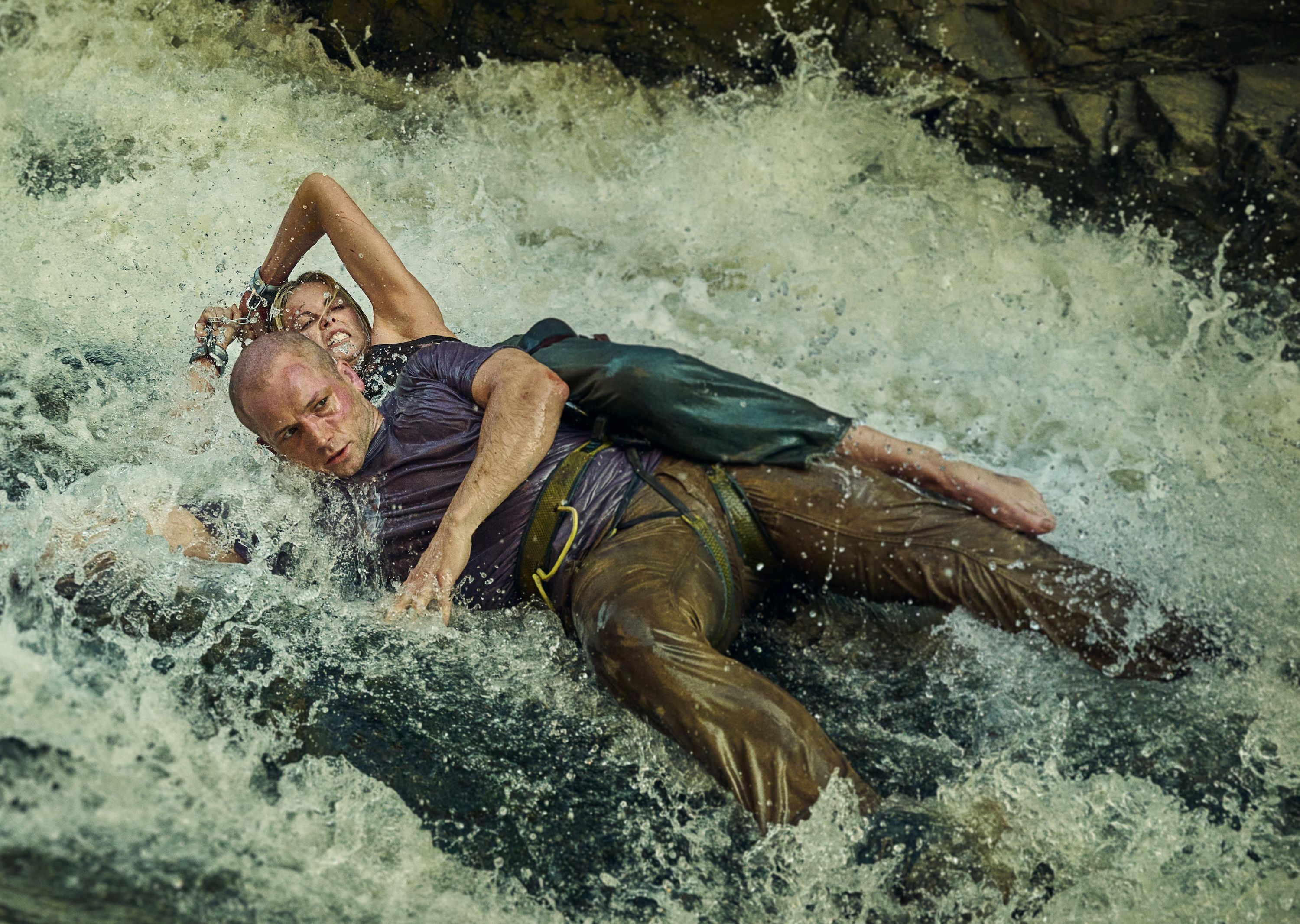
Apex isn’t really focused on surprises in general. Much like a Predator movie, it’s predictable but satisfying, as it explores the grueling lengths a hunted human will go through to survive. Sasha free-climbs cliffs, swims through rapids, whooshes over waterfalls, and fights Ben up close.

Sharks circling under a victim being dangled over water iN dangerous animals You'd also like...

Jai Courtney breaks out (again) as a dancing serial killer with a shark fetish

There are a couple of shocking horror-movie scares and a little startling gore, but this movie is more about long-haul endurance than about any particular jump scare along the way. Also like a Predator movie, it focuses on the ways a hapless victim pushes back against a hunter with superior technology, a stronger physique, and other advantages.

What Apex most has in common with superior Predator movies like Prey, Killer of Killers, and the OG Arnold Schwarzenegger movie, though, is an environment that’s a character in itself. Arguably, it’s more of a character than either of the leads — Theron and Egerton both do committed, exhausting-looking work here, but their characters are story functions rather than fully realized people. The scenery, on the other hand, is gloriously three-dimensional.

Taron Egerton hauls Charlize Theron across a sandy beach by a chain attached to a bear trap on her leg in Apex Photo: Kane Skennar/Netflix

Director Baltasar Kormákur (2015’s survival thriller Everest) and cinematographer Lawrence Sher (Joker and Joker: Folie à Deux) give Apex a stunning lushness. The movie is packed with deep colors, glorious texture, and striking sequences, plus plenty of drone footage showcasing unspoiled, rough wilderness. Apex’s narrative simplicity (and the fact that it’s a Netflix movie) might lend itself to second-screen viewing, but anyone who lets their attention wander to their phone is going to miss some beautiful footage that makes this story seem a lot bigger than it is.

What most differentiates Apex from a Predator film, apart from the obvious dearth of sci-fi elements, is the lack of focus on ingenuity and table-turning wilderness resourcefulness. Sasha doesn’t build elaborate traps for Ben out of sticks and stones, knap her own spear-points out of flint, or dig and conceal a pit to trap him. She just… endures, taking the damage Ben and the environment dish out, and refusing to submit. There’s never a speech about her biggest flaw becoming her biggest advantage, or similar underlining of the theme: This movie is almost as short on dialogue as it is on deep character work. Sasha is dogged rather than clever, as that opening scene about her refusal to acknowledge her limits implies, but the filmmakers leave that to the audience to take from her behavior.

The “tough character just refuses to die” dynamic makes Apex a wince-inducing string of impressively brutal blows for both main characters, but also means that even at a stripped-down 88 minutes (when you shave off the closing credits), the movie sometimes feels stretched to excess. There are three different long, lovingly detail-oriented sequences of Sasha climbing rock faces. Anyone who wants an illustrated primer of different kinds of grips, uses of leverage, or approaches in a difficult climb will get it here. But narratively there’s only so much nuance to explore in the different ways of getting around natural cliff formations.

Charlize Theron hangs off the side of a steep, rocky cliff in Apex Photo: Kane Skennar/Netflix

Similarly, the “plunged into rapids and trying not to drown” moments pile up. And while Sasha does try a few psychological approaches to humanize herself in Ben’s eyes, or avert his assaults, she mostly just glares at her tormentor, trying to burn holes in him with her eyes. It’s a little curious that, given so many decades of both “Most Dangerous Game”-derived movies and Predator movies exploring all the ways to bring innovation to a hunted-human story, screenwriter Jeremy Robbins (The Purge) goes with such a bare-bones, meat-and-potatoes approach.

It isn’t necessarily a problem that Apex almost never colors outside of its subgenre’s most basic lines. It’s an efficient, effective horror movie about the limits of the human body. But it’s almost entirely experiential and in-the-moment, with no deeper levels to unpack or explore, and nothing that makes it particularly memorable once the reveals are all in. It’s a fun watch, but hard to imagine people returning to it for a second viewing — or finding the premise or characters so engaging that they’re hungry for further Sasha adventures. That’s one advantage the Predator movies and “Most Dangerous Game” can claim: In both cases, the first one sparked people’s imaginations, leading to decades of successors and spin-offs. Apex is an enjoyable enough trip, but it’s also a bit of a dead end.


Apex debuts on Netflix on April 24.
Share:

More in Multi-platform

Netflix's Gritty Horror Sleeper Hit Is Still One of the Decade's Best Zombie Movies🎮 Multi-platform

Netflix's Gritty Horror Sleeper Hit Is Still One of the Decade's Best Zombie Movies

It's also a good reminder to keep a month’s worth of ramen on hand at all times

🎮 Resident Evil🎮 Netflix's Gritty Horror Sleeper Hit
PolygonNewsabout 1 hour ago
Ryan Gosling’s Near-Perfect Sci-fi Movie Officially Becomes an HBO Max Streaming Hit🎮 Multi-platform

Ryan Gosling’s Near-Perfect Sci-fi Movie Officially Becomes an HBO Max Streaming Hit

Ryan Gosling and Harrison Ford’s acclaimed sci-fi sequel Blade Runner 2049 has found a new streaming home on HBO Max.

PolygonNewsabout 4 hours ago
NBA 2K’s Best Mode Is Even Better This Year🎮 Multi-platform

NBA 2K’s Best Mode Is Even Better This Year

NBA 2K has long been the standard-bearer for high-quality sports games. It's the pinnacle that other series like Madden, FC, and even the oft-beloved MLB The Show aspire to emulate in whatever ways their respective sports allow. That's not to say it gets everything right, but it often feels like the team at Visual Concepts is competing against itself. It creates trends; it doesn't chase them. That's always been most obvious in The City, the series' social PvPvE hub and the lifeblood of the game's community. Though some other parts of the game are more uneven with this year's entry, The City proves that if you only plan to play one sports game this year, NBA 2K27(https://www.gamespot.com/games/nba-2k27/) is the way to go. The City is where players can meet up for basketball games of varying sweat levels, buy cosmetics, and complete live-service challenges--it is the center of NBA 2K27's solar system. This hub is thoughtfully attached to the single-player MyCareer mode at the proverbial hip, and this pairing offers more enjoyable and immersive things to do as a tandem than most other sports games taken in their totality. This year, The City makes several smart changes. At the core of it all is the long-awaited ability to import custom women characters into the mode. Aesthetically, this is a nice change that lets the hub world better reflect real-life streetball communities--it's always been true that women have existed in these spaces in real life, so they should be included in NBA 2K, too. However, this positive change does come with a frustrating caveat: The MyCareer mode doesn't account for them, thereby siloing these women avatars into The City exclusively. Plus, this requires anyone who wants to run around in The City as a woman to create a second avatar as a man if they want to go into MyCareer's story mode. So as awesome as this all is to see, it also feels like a frustrating half-step forward. !(https://www.gamespot.com/wp-content/uploads/2026/09/NBA-2K27-The-City-Female-MP-Gameplay.jpg?w=636) Finally bringing women avatars into The City makes for a more diverse and dynamic social space. New landmarks in The City, Casual Corner and Crew HQ, build out the virtual world to be much more inviting and social. In Casual Corner, beginner-friendly pick-up games, including some that are co-op PvE against rather lowly bots, are happening whenever you want to queue for them. Meanwhile, NBA 2K's clan-like "Crews" system gets a big upgrade in Crew HQ, a space for you and your crew to meet up, practice, play crew-only games, and socialize. These two additions will better onboard new players and, by being tied to the Learn 2K suite added in recent years, speak to the team's commitment to not feel so dizzying to new players. They also become two more diverse ways to play in a hub world already full of so many different offerings, from ultra-sweaty Proving Grounds games that ditch the shot meter to The Rec's full-length 5v5 games. There's always The Park too, where some players spend the entire year building out their in-game legend and dominating on a particular court as though they actually live in the neighborhood. In more than one corner of the game's social world, these various modes feel big enough to allow you to commit to any of them exclusively and still find a lot to love. My favorite of The City's modes, Street Kings, is akin to Mortal Kombat's Towers: PvE games against boss-type ballers that escalate in challenge with every match, and where a hype man and an energetic crowd of NPCs cheer you on like a classic And 1 game. Since it first appeared in the series two years ago, it's become my favorite way to play multiplayer in NBA 2K because it allows me and my brother to make lots of progress in The City's various progress bars, like player and season XP, without bumping into players who disrupt the more casual vibe we're aiming for. Of course, every year I'm compelled to shine a spotlight once more on the over-monetized aspects of The City. Visual Concepts is extremely adept at partnering with authentic-feeling brands that create aspirational cosmetics to purchase and unlock in The City, and that's fine with me, even in its abundance. Personally, I loved getting to walk around in a Portland Fire jersey for the first time, as my home city recently rejoined the WNBA. !(https://www.gamespot.com/wp-content/uploads/2026/09/NBA-2K27-The-City-Female-MP-City.jpg?w=636) It's past time for returning players to keep their in-game cosmetics year to year. But I will forever hate that players can spend money to improve their players right away. Paying past the grind that begins with players rated 60 overall (OVR) has long been an additional surcharge on players in the game's marquee mode. It's also true that avatar intricacies like skill badges, takeover abilities, and cap breakers all mean that initial pay-to-win buff is less effective than it may sound. Paying to bring my 60 OVR player to 79 OVR as soon as he steps into The City isn't as big a leap as grinding him to 99 OVR with multiple cap breakers and gold badges. Still, it essentially means NBA 2K is not a $70 game, but closer to a $100 game for anyone planning to play online with their friends. Attributes shouldn't be available with the same universal currency that also buys me my Rose City hat and a pair of virtual Jordans. I'll say it every year, even as it seems this is very much a feature for parent company Take-Two, not a bug. This year's game accidentally shines a light on a related topic, too. With The City taking on the same look (albeit with some added landmarks) as last year's, it serves as a more overt reminder that your purchases don't carry over, even if the virtual world's layout does. I really liked my avatar's Celtics hoodie last year, but seeing it in the shop again for a price, rather than just being available to me for free, felt especially annoying this year. The scenery is nearly identical, but the hoodie was apparently just a rental. There's so much for sale and new things are added frequently; it feels like it's time for NBA 2K to go the way of Fortnite and just let me keep my in-game purchases forever. The City is normally the social aspect of the custom avatar you'll build in the game, with MyCareer being the solo portion, but this year's game has built co-op into the MyCareer experience. However, it's a half-measure for now, and not as exciting as I once hoped when it was revealed. The narrative of MyCareer is much longer than usual this year, and the co-op portion of play only becomes available after several hours. At that time, the G League team you've landed with in the game's branching saga introduces a new teammate of yours in Trace Miller, a fake player invented for the story and meant to be the Player 2 of the story mode. This leaves your co-op friend feeling side-saddled. You can create your own avatar with your own intricately designed player build, even using your own face, but Miller is who he is, for the most part. Though you can choose his starting size and position, the build design tools are much simpler from there. The best version of co-op MyCareer would let both players fully customize their athletes, rather than leaving one feeling like merely the sidekick unlocked after many hours, as this first iteration does. !(https://www.gamespot.com/wp-content/uploads/2026/09/NBA-2K27-MyPLAYER-MP-Builder-2.jpg?w=636) Building your custom player is a richly detailed experience that many in the community treat like a science. The good thing is NBA 2K has long been great at taking an idea and building on it over time, rather than scrapping it if the first year or two don't satisfy players. It's an attribute that has separated this series from some other sports games, and I expect that North Star may affect this mode soon, hopefully for the better. There's a third way to live out the life of your avatar this year: MyCareer Eras. Borrowing the same remarkably deep Eras feature from the team-based MyNBA mode, MyCareer Eras lets you drop your fake player into any decade from the 1980s Bird vs. Magic era onward, thereby time-traveling to the NBA of yesteryear. In any era, you'll see period-specific presentation elements, rules, uniforms, rosters, and even audience attire. Eras were introduced in NBA 2K a few years ago, and they remain the coolest way to play Franchise-style. Though you could drop your avatar into MyNBA Eras last year, that was the extent of it. You were just a player on a team like any other. This year's version is a bespoke narrative experience that puts the spotlight on your player in a bygone era, full of challenges and emergent stories. Taking my avatar to the early 1990s and seeking to paint over the Jordan dynasty is an incredibly fun thing to do, and just like The City--or MyNBA, which, admittedly, takes a backseat in terms of sweeping changes of its own this year--MyCareer Eras is a mode I could enjoy for hundreds of hours. Though MyNBA doesn't get much of a look this year, it at least has received major overhauls in recent years. That's more than I can say for the game's suite of WNBA modes. Over the past three seasons and 2K sequels, my emotional investment in the WNBA has grown a lot, and with a local team making its grand reopening this year, I've been so excited to play as them in 2K. But having grown more attached to the league has led me to see some of 2K's shortcomings when it comes to the WNBA. !(https://www.gamespot.com/wp-content/uploads/2026/09/NBA-2K27-The-W-MP-Action.jpg?w=636) Even with several deep modes on offer, I hope the WNBA modes get more attention soon. For one, The W, its solo avatar analog to MyCareer, doesn't allow you to import your woman avatar from The City, which, like the lack of a truly customizable Player 2 in MyCareer, feels like a half-measure. But in MyWNBA mode, where you take on seasons of a single team, there's a lack of the same care the men's league gets. I'm sure the WNBA modes are played less, but I've always found it commendable how NBA 2K is a hub for all things basketball; only now I'm better able to see some of what's missing, like a robust halftime show and arena-specific ceremonies, the likes of which do exist in the real WNBA but only exist in the 2K version of the NBA. I'm hopeful that, as the league continues to grow, 2K's WNBA modes can grow with it. It's great to see women in the game more, like in The City or in MyTeam, where they first arrived last year, but in their own bespoke game modes, some of the details this studio is otherwise so great at building into the experience are lacking. I've spent a lot of words on not talking about gameplay, which might seem weird, but it's because this year's game feels the most year-over-year familiar to me of any game of recent memory. That's not exactly a bad thing. NBA 2K is a lot of fun on the court. It has been, so it is again. And it's not that the game adds nothing. In particular, I really like the new step-through finishing moves, used to finish a shot after you've lost your dribble. Like other aspects of on-court animations, lots of these are modeled after real players' go-to moves. Visual Concepts has been using ProPlay, its in-house tech that transposes real NBA footage into gameplay animations, in ways that are hard to specifically attribute from outside the confines of the studio, but if ProPlay is why the game looks and feels so good, I'll take it. Combined with the game's continuing efforts to teach newcomers how to play 2K, as well as changes in The City, it feels like the series has never been more approachable. While playing online can bring out any number of cheesy players who seek to break the game in their favor, this is true of all sports games and is usually improved upon if you stick to specific modes, like Rec games, where the crowded court of 5v5 gameplay minimizes any cheesehead's worst intentions. In games against the computer, I continue to be amazed by how different players and teams--even those spanning different eras--have their own playstyles. Playing the Celtics, you'll get a heavy dose of Mazzulla Ball, while the Spurs rightly center everything around the unique size and talents of Wemby. This is a fun basketball game not just because of the depth and breadth of its modes, but also because its foundational gameplay is easy to enjoy and closely resembles watching the real thing. !(https://www.gamespot.com/wp-content/uploads/2026/09/NBA-2K27-MyCAREER-Eras.jpg?w=636) Taking on different eras of the league and the legends who made them memorable remains the coolest mode in sports games. Overall though, if NBA 2K is truly competing against itself, this year's game is a slight step back. While the addition of co-op to MyCareer and women to The City are great first drafts of ideas, they each come with caveats for now that keep them from being as fun as they could've been--and reasonably should've been. On the court itself, NBA 2K is still a lot of fun, but it has seemingly settled into a groove for now, iterating in smaller ways after previous years' bigger leaps. There's room to grow in the WNBA side of the game, though with The City, MyCareer, and Eras modes, it's not short on deeply immersive experiences already. I have enough fun with NBA 2K each year that I tend to delete it from my console after the new year; otherwise, I risk never playing anything else. It can be that good. But just as I was ready to commit to the game for the full year, with my heightened fandom in tow, it's given me an installment I feel more comfortable walking away from--right after I delete the Jordan dynasty and beat all the Street Kings.

🎮 NBA 2K🎮 Madden
GameSpotReviewsabout 5 hours ago