Silent Hill: Townfall is the most Scottish game I've ever played and the most effective horror game I've seen in ages: 'It made sense for us to dig deep into our upbringings, into our past, and try and build a place that felt believable'
Overview & Key Takeaways
And not just because of the foul weather.
Silent Hill has gone international. Last year we went to Japan in Silent Hill f, and now the series is off to Scotland in Silent Hill: Townfall. As a middle-aged Scot who still remembers the '90s, when Townfall takes place, I was simultaneously nervous and excited about the rare opportunity to play a game that's so close to home.
What a relief, then, that Townfall not only feels incredibly Scottish, its Scottishness also perfectly matches Silent Hill's brand of unsettling psychological horror. And it's not such an unlikely pairing. Scotland is a brilliant fit for this kind of game—and I'm going to spend the next 2,000 or so words convincing you why.
It helps, of course, that the studio is both local and knows its way around the genre. Glaswegian developer Screen Burn has been serving up frights and mysteries since 2015, namely through Stories Untold and Observation. You might know it better by its former name, No Code. Co-founder and Townfall game director Jon McKellan also worked on Alien: Isolation prior to starting up the studio.
Welcome to St. Amelia
(Image credit: Konami)
"We wanted St. Amelia to feel like a real place," McKellan tells me. "And I think, as with most writing, you write what you know, and it made sense for us to dig deep into our upbringings, into our past, and try and build a place that felt believable. To make the player care about this place, you need it to be believable.
We wanted St. Amelia to feel like a real place.
Jon McKellan
Walking the streets of St. Amelia is an eerie experience because it all feels so familiar. There are still so many towns in Scotland that look like this—that mix of old fashioned architecture, cosy little shops and tiny fishing vessels sitting next to modern medical clinics and parked cars. The odd new flourishes squeezing into old spaces.
Outside a shop I notice a pair of charity boxes—one in the shape of a guide dog, another a swirly wishing well that looks like a helter skelter—that nearly everyone from the UK will recognise, not just Scots. These tiny bits of window dressing make the fictional town feel like a tangible place. I have absolutely been here before, even though I definitely haven't.
(Image credit: Konami)
"A lot of it was going back through our old memories and trying to find things that we remembered, finding old photographs," says McKellan. "But also some genius out there had scanned every Argos catalogue for the last 30 years, and we were like looking at them and finding out, OK, if we need a TV in '90s, let's look at the catalogue from the '90s and find out which one would be more appropriate."
If you want a dose of '90s shopping nostalgia, here's an Argos catalogue from 1990. Enjoy looking at decades-old lawnmowers and kitchen utensils!
Being set in the '90s also means that technology can't really save you. You don't have a miraculous smart phone in your hands, and satnav was still very new. All you have is your CRTV, a chunky portable TV—just like the one I had as a teen—that picks up fuzzy signals, which you can use to solve puzzles and see where enemies are.
"They're kind of frail, they're unreliable," says McKellan. "I think all of that speaks really well to horror because you get these tools and they help you, but they're never going to be good enough to get you out of a jam. Relying on the analogue, it allows you to play within those limitations, which work well with horror. I think aesthetically as well, it adds texture, even just to the real-world tactile interfaces that feel just a little bit more grounded. Anything we can do to make the player feel like they're there is going to help with horror."
Weather alert
(Image credit: Konami)
It wouldn't be an accurate portrayal of Scotland without our horrible weather, of course, which turns what would otherwise seem like an attractive, inviting town into a dour, dreich place. It's foggy and grey, the Scottish default. Normally, though, that would seem quite welcoming to me. Us Scots are a weird bunch and we're abnormally proud of our shite weather.
It wouldn't be an accurate portrayal of Scotland without our horrible weather.
It's not just because we're pessimists revelling in misery (well, not entirely); there's actually a streak of optimism in the Scottish psyche, with so much Scottish art being about finding beauty in stark, gloomy places. Some of that art is even in my living room, where I've got a trio of prints depicting one of my favourite locations, the gorgeous island of Arran—presented as a jet-black rock—surrounded by a storm.
At a most basic level, it's just nice to be in your cosy home looking out the window at the rain pishing down or the fog rolling in. And Townfall preserves this. While there are plenty of horrors hidden in the buildings, at least in the early part I was playing the streets are a lot more deadly, with the mist hiding horrors drawn from Simon—the protagonist—and St. Amelia's trauma. It feels safer indoors.
(Image credit: Konami)
When Scotland is presented in videogames, it's usually a brief aside or approaching parody—all kilts and whisky and golf, with accents that call to mind fantasy dwarves. Townfall is more confident in its Scottishness—it doesn't need to scream about it at the top of its lungs. It's an understated familiarity, which lends it a more potent air of authenticity.
In the '90s, most of the world's experience of Scotland came through two movies: Braveheart and Trainspotting. Unsurprisingly, a Hollywood production featuring an Australian nutcase didn't quite capture the country. Trainspotting certainly did, though. It reflected the less palatable side of Scotland, the one the tourists rarely get to see: the squalor, the addiction, the depression and urban decay.
Townfall is much closer to Trainspotting than Braveheart, but rather than urban poverty and heroin addiction, it explores themes like medical trauma, the evisceration of small communities and the social impact of Margaret Thatcher's rule—one of Scotland's most loathed villains, right up there with King Edward I of England, the man also known as the Hammer of the Scots.
Trauma team
(Image credit: Konami)
"The medical trauma is something that Simon's clearly involved with," says McKellan. "Without going into too much detail, I think again you kind of write what you know, and a lot of the experiences that Simon and the characters have have come from a real place and come from something that's pretty authentic in terms of how we cope with those things. So it also felt Silent Hill. It felt like the kind of story you would expect in a series like Silent Hill, without copying anything that's come before."
I think relatability is a big thing in horror.
Jon McKellan
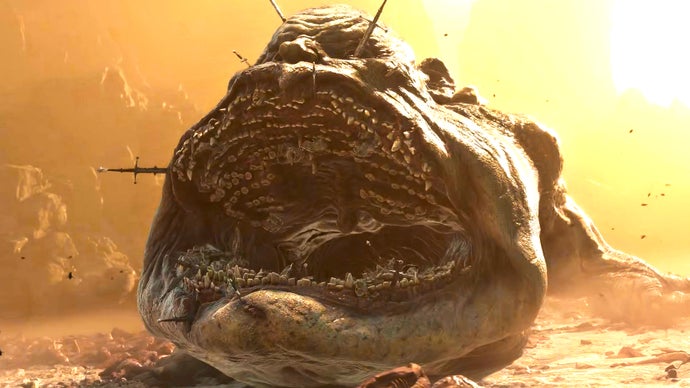
The way this is presented is extremely harrowing. In one early scene, we see a character Simon knows standing in the town square, when a huge tube suspended from the sky appears and plugs into his mouth. There's a hint of cosmic horror in the scene—tentacles coming from the sky—but also grounded psychological horror, that traumatic experience of being hooked up to medical equipment with feeding tubes pumping their contents into your stomach. It's nauseating.
"I think relatability is a big thing in horror," says McKellan. "The more you can relate to a problem, the more you can understand it. The more you can be frightened of it. The more you can be affected by it. And I think some of the themes and issues that we dive into in Townfall, some of them even very subtly in the background, I think a lot of people connect with it and have a stance on it, have an opinion on it. Like say the time period, the setting—it's all really relevant, and it creates a perfect storm for what has happened in St. Amelia that I think a lot of us could relate to, whether you're from Scotland or not."
(Image credit: Konami)
But what actually happened in St. Amelia?
Townfall's introduction only provides hints. A company is referenced. There are protest signs scattered around the town square. Tension permeates everything. This is a town that has been through some shit—like so many Scottish towns of the era.
"I won't spoil what happened in St. Amelia and the journey that you'll go on there," says McKellan, "but there's a lot of imagery from those eras, growing up in the '90s and the era of Thatcher, things like that. It was a very tense climate at times, and I think there was a lot to draw from them for inspiration in terms of how it would look and feel for a town to be angry about something, and how it feels to protest."
The protest signs I see are real, as in Screen Burn actually made physical protest signs, scanned them and added them to the game, "to make sure it felt like this is what it would look like". The studio didn't simply want to make copies, it wanted to make the real deal, something authentic. Something that reflects "what life was like", even if the game isn't technically about what life was like—this is still Simon's story. And Simon is an outsider.
Stranger things
(Image credit: Konami)
If you're a stranger to Scotland, you'll be fine in St. Amelia. While I can feel the Scottishness sweating out of Townfall's pores, it's often subtle, and knowing anything about Scotland is not a prerequisite. I've never visited Japan, but that doesn't stop me from getting something out of Silent Hill f, or being obsessed with Like A Dragon.
We wanted the player and Simon to be kind of in lockstep
Jon McKellan
Simon is American. He is an outsider exploring an unfamiliar town. He's the perfect viewpoint for players—even if you are Scottish. The town, initially, is an enigma. We don't know what happened here or what's going on. We need to unravel the mystery.
"We wanted the player and Simon to be kind of in lockstep," says McKellan. "I didn't like the idea that Simon would come to the town but know his way around, or have amnesia and not know where things are. It made more sense that both Simon and the player see this for the first time. So all the discoveries that you make, Simon makes too, and that keeps you more more connected with Simon throughout the story."
(Image credit: Konami)
The first-person perspective really emphasises this. I don't know about you lot, but third-person horror isn't nearly as thrilling and stressful to me. It's more like watching a film, and while I love horror films, it's rare for them to actually succeed in making me scared. Videogames have an advantage in that you're participating in the horror, but if you're inundated with UI elements and seeing your character at all times, it sheds a lot of the uncomfortable intimacy. When you're seeing through your character's eyes, however, it's a lot more effective.
"It gives us a kind of intimacy with the environment that is hard to do in third-person," says McKellan. "With the environments we've got, because we're in first-person, we didn't have to scale everything up. We didn't have to make the doors wider to let the camera through with you. We could keep everything to the right scale and make it feel quite dense and claustrophobic. So in terms of the horror, it's really helpful. It gets you close to the horror. There's no one in between you and the thing in front of you."
McKellan also notes that it really helps with the storytelling, too, "letting you explore that town and feel like you're really digging through people's cupboards and understanding where they lived". It bestows St. Amelia with a stronger sense of place, which feels essential in a game where the setting is so critical and looms so large.
(Image credit: Konami)
I can't imagine using the CRTV in third-person, it would feel so clunky, and that was a big consideration for Screen Burn as well. "You just can't do that kind of mechanic from a camera far away without relying on UI overlays and making it feel almost sci-fi," says McKellan. "So we felt like doing it diegetically in your hand was a must-have."
I was living through a horror story in my own backyard.
I played Townfall in a well-lit, hot room surrounded by other journalists as a fan blew directly in my face. There probably isn't a worse way to experience a horror game. But I was genuinely entranced. St. Amelia's thick, thick atmosphere, the obsessive attention to detail, the juxtaposition of the familiar and the horrifying—I was no longer an exhausted journalist trying to get through another Gamescom appointment, I was living through a horror story in my own backyard. And it was awesome.
Silent Hill: Townfall launches on September 24.