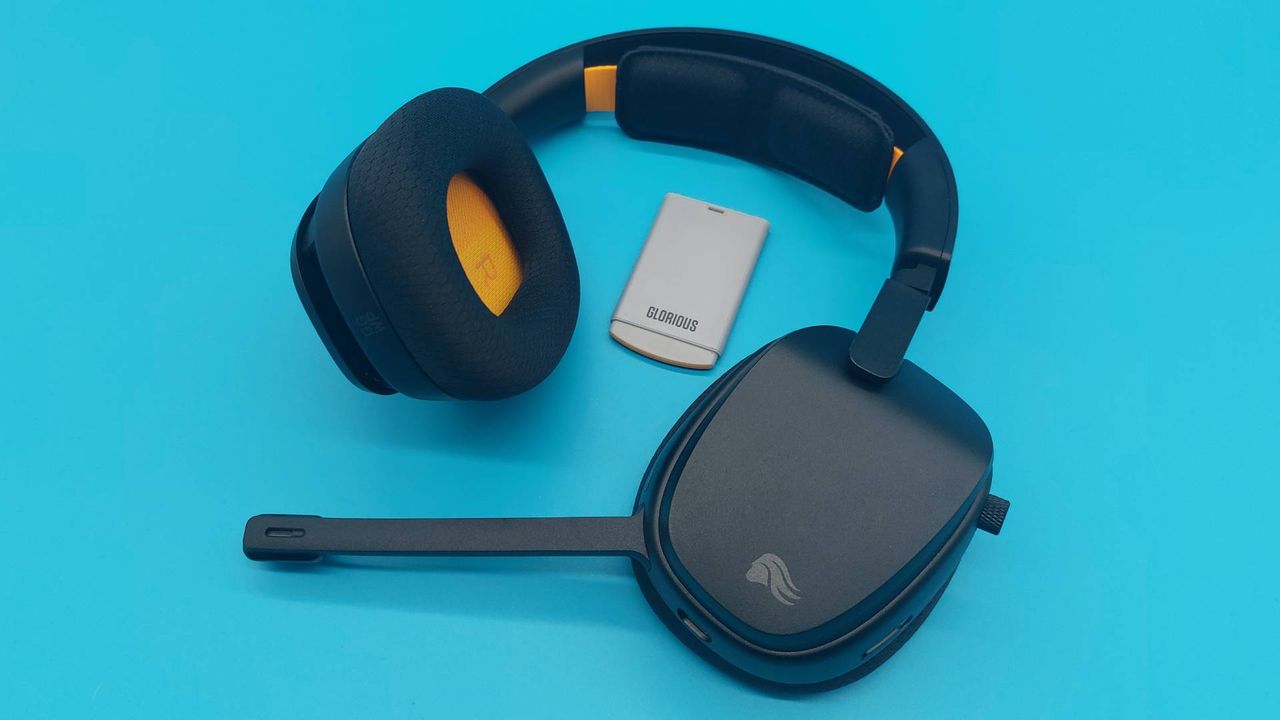
Glorious GHS InfinitePlay review
Overview & Key Takeaways
This versatile set of cans impresses with its hot swappable battery system, but it's just okay otherwise.
Glorious, purveyor of PC peripherals such as gaming keyboards and mice, has branched out into headsets. The company released its first wired effort, the Glorious GHS Eternal, earlier this year and, in terms of build quality, the wireless InfinitePlay shares a lot of DNA. In terms of pricing though, the two headsets couldn't be more different.
The swappable battery system goes some way to justify the significant jump in price. As someone who loves wireless headsets, but doesn't love how often they have to become tethered to my PC to charge, this proved a real game-changer.
The InfinitePlay is also designed to be a versatile bit of kit you can take everywhere. Whether you're listening to tunes on the go, or counting the shots in one of the best FPS games, the InfinitePlay's balanced sound profile is tuned to handle both scenarios equally well. EQ tweaking is offered via the straightforward to use Glorious Core software, with more in-depth options planned for a future update.
Latest Videos From
That versatility is backed up by great connectivity. You've got the usual choice between a Bluetooth, or 2.4 GHz connection, and the dongle for the latter comes with a USB-C to USB-A adapter. As such, it's just as easy to connect the InfinitePlay to your phone, PlayStation and Nintendo Switch consoles as it is to your PC.
Generally speaking, the GHS InfinitePlay is a wireless gaming headset that could handle everything I threw at it—and, thanks to its sturdy yet flexible construction, survived everywhere I threw it. Unfortunately, for $230, I'm not sold that this headset gives quite as good as it gets.
Buy if:
✅ You want a versatile bit of kit that doesn't draw attention to itself: Neither creaky in construction, nor showy in appearance, the InfinitePlay is a gaming headset you can take on plenty of adventures away from your gamer den.
✅ Oodles of battery life is a priority for you: The InfinitePlay's hot swappable battery system is impressive at this price point. Each battery offers about 85 hours, and the headset itself can store up to 3 hours of juice itself, meaning you never need to hit the pause button to swap.
Don't buy if:
❌ You're totally addicted to bass: The InfinitePlay's sound profile is balanced, handling much of what you can throw at it equally well while also lacking the depth or richness to stand out in any particular way.
❌ You're on a budget: The InfinitePlay is one of the least expensive gaming headsets featuring a hot swappable battery system you can get right now, but $200+ is still a big ask.
Boasting about 85 hours of up time from each of its hot swappable batteries, there's a lot to like about the InfinitePlay. Unfortunately, over $200 is still a lot to ask for a wireless gaming headset, even if it does manage to side step the need for a wired connection to charge.
A balanced sound profile, and flexible but sturdy construction will handle everything you throw at it. However, for the price, I was hoping for just a bit more of a flourish from either department.
Features
Swipe to scroll horizontally
| Row 0 - Cell 0 | GHS Wireless InfinitePlay |
| Type | Closed-back |
| Connectivity | Bluetooth 5.4, 2.4 GHz, USB-C Wired |
| Frequency | Response 20 Hz - 20 kHz |
| Mic | Omnidirectional, detachable boom arm |
| Weight | 360 g |
| Extras | 2x hot swappable batteries, charging base station for the hot swappable batteries, USB-C to USB-A adapter for 2.4 GHz dongle |
| Price | $230/€230 |
The main draw of the Infiniteplay is its swappable battery system. Each battery holds an advertised 85 hours of charge while the headset itself can stay powered on for three hours under its own steam. That means, your headset doesn't need to power off when you swap between batteries
We've seen similar systems in both the SteelSeries Arctis Nova Elite, and the SteelSeries Arctis Nova Pro. The InfinitePlay costs a fraction of the Nova Elite's $600 asking price, and a significant chunk of change less than the Nova Pro, which itself will still set you back somewhere in the region of $300. The InfinitePlay's $230 price tag still isn't what I'd call affordable, but it does offer more than twice the battery life of the more expensive SteelSeries headsets—seriously, I was charging the Glorious batteries in their special included base station maybe once every two weeks.
Keep up to date with the most important stories and the best deals, as picked by the PC Gamer team.
Swapping between batteries feels natural. There's no hidden compartment here, and therefore no magnetic cap that could disappear among the clutter of your gamer den. Instead, you just slot a freshly charged battery into the right earcup. It does matter which end of the battery goes in first, with the non-business end highlighted by an orange tip. Otherwise, the socket is much less picky about which side is the right way up, so you won't be futzing and flipping your batteries around like they're a USB-A cable. Easy-peasy.
Besides hot swappable batteries, or the impressive, detachable microphone which I'll discuss in its own section, what I personally most enjoyed were the tactile rotary knobs on both earcups. Pressing in the left knob powers on the headset, while tapping gives you a broad sense of how much juice is left in the battery. Twiddling the left knob also finetunes your chat mix, while twisting rightie adjusts system volume. Tapping the right-hand dial also pauses the current song.
(Image credit: Future)
The two rotary dials are a delight to use, and each one is joined by a lower profile button lower down the earcup. The left ear cup button mutes the mic, and the one on the right earcup turns on Bluetooth with a long press, or switches between your Bluetooth and 2.4 GHz connection with a tap. These lower profile buttons are fine, though they're much less fun to use.
Sound
The InfinitePlay enjoys a balanced sound profile with various EQ tweaking options available via the Glorious Core software (scroll down for more on that). But even without audio twiddling, the InfinitePlay handles both music listening and game soundscapes equally well. However, that balanced sound profile also means it doesn't especially stand out in any particular regard.
That's fine, but for this price point I would want just a little more depth and richness—a little more bass wouldn't hurt either. Instead, Glorious is pitching this as more of a versatile device you can comfortably use both in and out of game, rather than an overly specialised bit of gamer gear.
(Image credit: Future)
Still, in-game performance matters. Granted, I could wax lyrical about my daughter's street fighting career in Magical Princess, but the mostly chill soundscape of this raising game doesn't really put the headset through its paces. So, for my yearly rhythm game humbling, I took DJMAX Respect V for a spin, and was particularly impressed with how crisp the high tones sounded via the InfinitePlay. The many voice lines of short, scifi fable Eliza also came through crisp and clear. The funky, crunchy soundscape of Doom: The Dark Ages is also faithfully rendered without the details of a hectic firefight becoming too muddy.
That said, the Glorious plan was to build a versatile bit of hardware with sound you could tune to your liking. As such, I'll save my thoughts on EQ profiles for the software section down below.
Microphone
(Image credit: Future)
The InfinitePlay's detachable microphone proves to be another stand-out feature. For instance, when I first tested this wireless headset in a video meeting, one of my colleagues commented that the mic was so clear that it made me sound like I was part of her inner monologue. Beyond considering a career as someone's literal shoulder devil, that is to say this headset could be a real contender for streamers (or, simply anyone just as enamoured with the sound of their own voice).
I'll talk more about the software specifically in a minute, but Glorious Core offers a few settings that bolster the microphone's performance, such as an Environmental Noise Cancellation toggle. Contrary to popular belief, PCG towers isn't the rowdiest office, though this noise filter definitely helps during team video calls.
Because Glorious are pitching the InfinitePlay as a versatile headset meant to handle your auditory needs both in and out of game, you have the choice between letting the detachable boom arm render your dulcet tones, or trusting an internal microphone to keep up. The detachable microphone arm is sturdy, with a little bit of flex as opposed to the properly bendy arms on Glorious' wired headsets.
As I said before, I got the best results using this detachable arm. Detach the boom arm though, and you have a headset that looks much less gamer-y, but with a much less strong internal microphone. It's mostly clear enough, but I wouldn't want to take a phone call on a crowded street or on a windy day with it.
Build quality
(Image credit: Future)
Like I said up top, the InfinitePlay is very similar in construction to the Glorious GHS Eternal wired headsets. That means they both feature a fabulously bendy-but-still-sturdy headband. Specifically, the InfinitePlay goes for the same floating headband design as the pricier, RGB version of the Eternal. Much like that wired headset, the InfinitePlay managed to endure a number of trips stuffed into my over-full backpack, coming out no worse for wear on the other side.
Besides being a wireless headset, the InfinitePlay's design differs from the GHS Eternal in two notable ways. For one, it's got two lovely tactile knobs, one on each ear cup, for adjusting volume and chat levels. For another, it does away with its siblings' bendy mic arm and opts for a much less flexible, detachable arm instead. There's some give to this arm, but it's not as poseable, and feels way more robust.
(Image credit: Future)
Otherwise, the InfinitePlay's hardware profile is very nearly the same as the GHS Eternal RGB. That means you're getting decent build quality for the price as far as that wired headset is concerned, but standing this side of the $200 mark with the InfinitePlay, the amount of flex possible here may prove more disconcerting than reassuring.
Aesthetics
(Image credit: Future)
Glorious haven't yet announced any fun colourways for the InfinitePlay—as a smaller company only just dipping its toe into gaming headsets, that makes sense. What that left me with was a classy black colourway with orange accents on the floating headband and inside the earcups. A white version is also available, though that goes for a grey headband and earcups instead of orange.
In all, my review unit is a fairly understated bit of kit in black. Even the rotary knobs are perfectly in proportion and don't draw a great deal of attention to themself. The microphone arm is a sleek thing, and the option to fully detach it makes this headset an unassuming bit of kit to take on the road with you. Personally, I prefer a versatile bit of kit that also comes in a fetching purple, but I won't begrudge those who prefer a more understated colourway—after all, black does go with everything!
Software
(Image credit: Glorious)
The InfinitePlay comes out of the box with decent microphone audio and a balanced sound profile, but the Glorious Core software offers a number of settings to better hone your experience.
For listening to your favourite tunes (or in my case most recently, going absolutely feral to The Vampire Lestat's singles), the Music and Immersion EQ profiles offer a lovely wide sound stage. You can't tweak the parametrics of either these, or the other Voice Call, FPS, or 'Glorious Mode' pre-set EQ profiles, but Core offers you two custom profiles to futz around with via a fairly intuitive UI.
Doom: The Dark Ages arguably features the weakest soundtrack of the trilogy, but its layered soundscape proves a worthwhile test of any gaming headset. I played the game across a few of Core's pre-loaded EQ profiles, and feel that on the whole both hardware and software are up to the task of faithfully rendering the sound design's redoubled efforts to really sell the heft of every step you make as the Doom Slayer. As far as I can hear, the FPS EQ makes the sound stage slightly narrower compared to the Immersion profile.
(Image credit: Glorious)
Generally though, I didn't notice the biggest difference between the pre-loaded EQ profiles, but I'm told that glorious is planning to beef up its software offering with the addition of advanced EQ options in future Core updates. Per the press release, the plan is to introduce "exact frequency placement, gain and volume per band, Q factor (the width of each adjustment, from narrow and focused to broad and sweeping), and full filter type selection across low pass, high pass, peak, low shelf, and high shelf." Unfortunately, these specific software features were not available to test for my review.
At time of writing, the software offers a number of other options beyond EQ settings too. You can also adjust game and chat sound balance via slider. You can adjust microphone volume, turn sidetone on or off, adjust sidetone volume, and turn the Environmental Noise Cancellation for the microphone on or off too. You can fiddle with all of these and the EQ settings across up to five different headset settings.
Value
(Image credit: Future)
That $230 price point makes the InfinitePlay markedly cheaper than a number of competing gaming headsets also rocking swappable battery systems—but dropping 200 smackers on a gaming headset is still a big ask. To reiterate, the Turtle Beach Stealth Pro can still cost more than $300—though our Katie wasn't especially fond of it anyway, giving it a 60% back in 2023. Turtle Beach's successor headset, the Stealth Pro II, offers an improved feature set though is even more expensive, and enjoys only 40 hours of juice per battery. Then, there's the $400 SteelSeries Arctis Nova Pro Omni which is definitely very snazzy, but still only offers up to 60 hours per swappable battery.
If we were just comparing battery life, then the 85 hours offered by each of the InfinitePlay's swappable batteries would ensure the Glorious wins out easily. The headset's own three hours of onboard juice just sweetens the deal, meaning you don't have to power off while swapping batteries. But obviously, wireless gaming headsets are more than just the sum of their battery life.
The audio quality of the detachable microphone is another highlight, but it's not quite enough to justify the price cruising past the $200 mark. Furthermore, while I don't dislike the well-balanced sound from the InfinitePlay 40 mm drivers, I would've appreciated more of an attempt at bass for the price.
Best gaming headset 2026