Resonance: A Plague Tale Legacy Is Good If You Do The Necessary Homework Beforehand
Resonance: A Plague Tale Legacy(https://www.gamespot.com/games/resonance-a-plague-tale-legacy/) faces a difficult balancing act. Can it move away from its predecessors' terrifying waves of rats and still deliver a supernatural terror that ties into rewarding environmental puzzles? Can it ditch the series' sibling protagonists and still tell a moving story focused on two people learning to lean on one another? And can it add fierce, frenetic combat to the franchise's formula as a new gameplay pillar without abandoning its core identity as a puzzle game? At times, Resonance succeeds--especially during its stronger first half--but it too often loses its footing. And as the game increasingly misses the mark, it further distances itself from what worked so well in the first two A Plague Tale games without adding anything to make up for the loss.
Set in 1334, about 15 years prior to the first two A Plague Tale games, Resonance follows Sophia instead of series protagonist Amicia de Rune. As a young girl, Sophia was forcibly injected with blood that causes her to have visions of a long-lost civilization. Wanting to cure her of these visions, her father eventually finds and travels to the island that she has seen in her visions, but in his attempts to uncover the island's history, he is killed by a mysterious and terrifying beast. Wanting to discover what her visions mean and learn about what truly happened to her dad, Sophia travels to the island with her best friend, Leni, in tow.
!(https://www.gamespot.com/wp-content/uploads/2026/08/ss9ff81a313610c1e31177a94a7c2ff3f8ec17e2ab.1920x1080.jpg?w=636)
The story, especially in the first half, is very good. This series has consistently done a fantastic job of quickly building up characters or situations in its introductions to be narrative buy-ins that are solely there to be destroyed or yanked away early on and create emotional stakes: Amicia's happy family life in the first game, the hope that Amicia's life had returned to some degree of normalcy in the second game. Resonance does the same. You actually spend quite a bit of time getting to know Sophia in Europe and the fairly happy life she has with the adopted family of smugglers she grew up with before a tragic event forces Sophia to go to the island. There's a real sense of desperation in her tale, and the stakes of what may happen to her or Leni if she were to return to her allies empty-handed and without answers are abundantly apparent.
Leni and Sophia have an odd dynamic. Narratively, it's pretty good. There's some angst beneath the playful banter of the two friends that implies there could be romantic feelings pushing the two together, and the two play off one another in cutscenes incredibly well with their very different skill sets--Sophia is a fighter who can muscle through problems that require strength, and Leni is a pickpocket who is adept at getting in and out of places she doesn't belong.
!(https://www.gamespot.com/wp-content/uploads/2026/08/ss1218579fae82e00d1c459c3ea880d89854494e31.1920x1080.jpg?w=636)
But that's never reflected in the gameplay. Leni can hold her own in a fight just as well as Sophia can (she even one-shots whichever enemy she's dealing with as soon as you handle the second-to-last foe) and regularly helps out with pushing open heavy doors and moving partially stuck levers. And at the same time, Sophia can squeeze into any spot Leni can and is usually the lead on how to solve puzzles (because she's you, the player!). The story does a great job of framing that these two are only succeeding because they have one another, but then this framing is repeatedly struck down whenever the cutscene ends and control returns to you. Again, it all feels very odd, like Resonance is holding onto its partnership framing for no other reason than that the first two games used it.
The mysterious, newly discovered island that Sophia and Leni find themselves on is quickly revealed to be Crete, what was once home to Minoan society and, if the myths are to be believed, a minotaur-inhabited labyrinth. The characters don't know that--it's 1334, so all of those stories have yet to be uncovered again.
!(https://www.gamespot.com/wp-content/uploads/2026/08/sseb5c2bfe44017bede10d1e649966804922e518c3.1920x1080.jpg?w=636)
This is a terrific framing for a puzzle game. As Sophia, you carry a book loaded with drawings from your childhood visions, your dad's early attempts to explore the island, and all the follow-up expeditions that the smuggling gang undertook after his passing. There's no writing--it's all a series of drawings. And using those drawings, you have to figure out how to retrace the steps of those who came before, while also finding your own way forward when unexpected roadblocks pop up.
To aid in her and Leni's exploration, Sophia possesses an artifact that dates back to the Minoan society that once lived on the island. The sphere can redirect light to reveal hidden symbols left behind with invisible paint, and also open doorways that require lining up beams of light to hit certain points on a wall. These puzzles centered around the use of light are rarely complicated, but contribute to the feeling of Sophia and Leni being intelligent dungeon delvers who are uncovering long-lost history.
!(https://www.gamespot.com/wp-content/uploads/2026/08/ss8a6c212059ef9362a864e84d9b647cbbfedeb4b2.1920x1080.jpg?w=636)
The process feels as I imagine archaeology to be--I don't believe Sophia's journey is in any way accurate to uncovering forgotten ruins and unraveling ancient mysteries, but the idealized fantasy of it is well represented here.
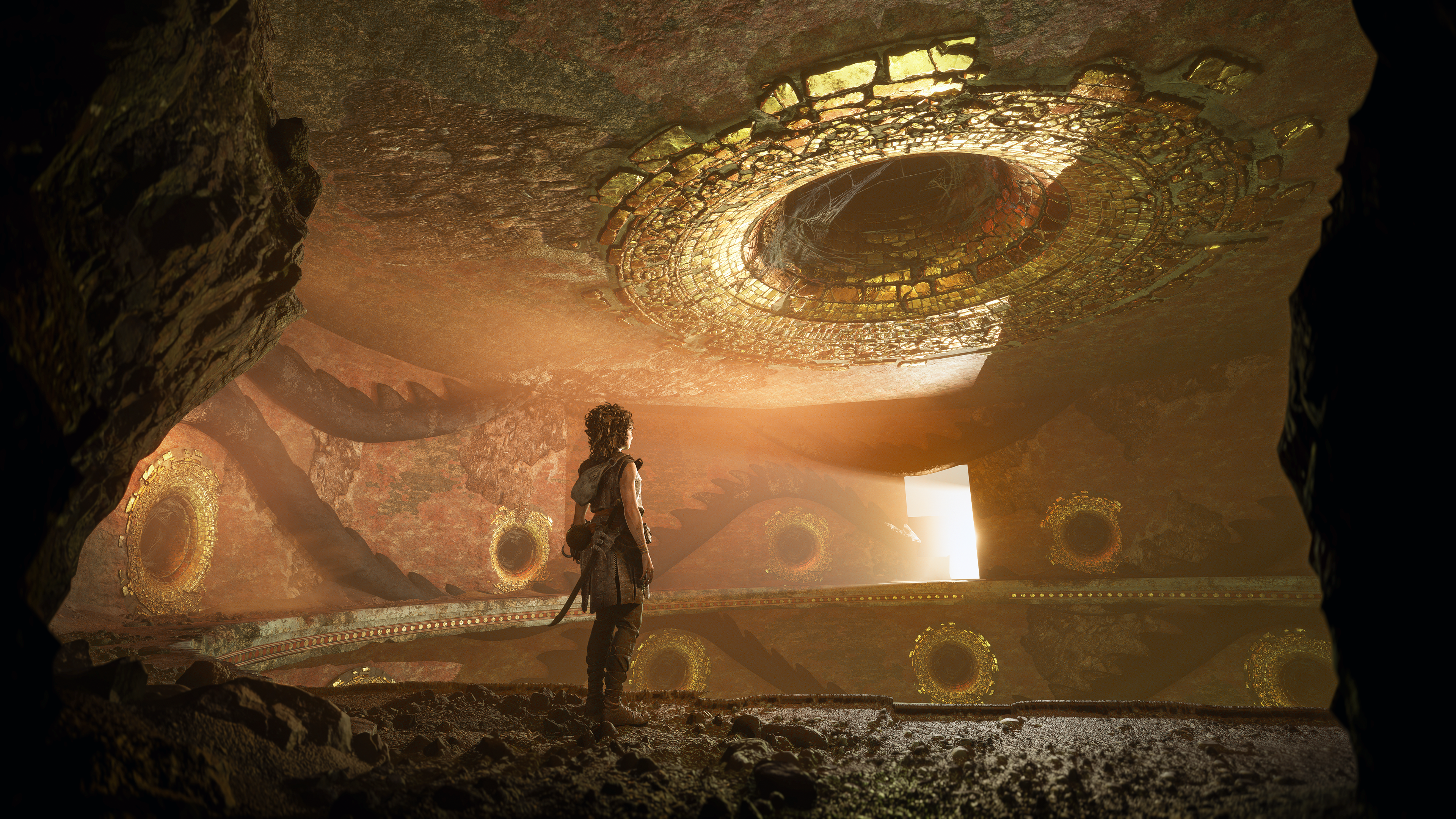
Crete is also a beautiful place to explore. The island is brightly lit and full of vibrant greens, reds, and blues, while the faded bronze of statues, broken weapons, and simple machinery mark Minoan society. Resonance also has the best soundtrack of the series, sticking to strings to frame most of Sophia's journey as a grand adventure or odyssey, and crucially plucking at the tension once the supernatural terror begins to rear its head.
!(https://www.gamespot.com/wp-content/uploads/2026/08/ss8800f39e3437f77dd5e2a410d17345c7ea5856ed.1920x1080.jpg?w=636)
It takes Resonance longer than any other A Plague Tale game to reveal its monster, but once it does, any semblance that this will be a fun couples adventure for Sophia and Leni is gone. The beast is creepy, slinking through the darkness of the island's underbelly in search of any and all life. In these darkened areas, Sophia becomes covered in softly glowing blue lights, and she leaves a trail of luminescent tracks whenever she's not crouch-walking. The beast can use these trails to track her, but it also will pause to take a hauntingly raspy sniff of the air--if Sophia is not behind cover when this happens, the beast will sniff out the blue lights on her and pursue her. The beast's only weakness is light. It burns away upon touching any light source, and so encounters with the beast are a series of tense stealth sections as you bravely venture into the dark to reach the next source of light.
These sections are terrifying, especially the first one as the beast is introduced and you finally get to see what killed Sophia's father. These moments stay pretty consistently creepy too, with the sound design of the beast's methodical movements and desperate breathing creating a tense and frantic atmosphere whenever it shows up. And Resonance continues to raise the bar with each encounter, adding new types of obstacles to consider (like how to find safety in areas where the beast can dim the light, or there's no light whatsoever) and more types of enemy terrors for Sophia to encounter in the dark. It's certainly the most memorable take I've ever seen of Crete's infamous minotaur.
!(https://www.gamespot.com/wp-content/uploads/2026/08/ss822d39e2d2c1a4920a336de73201bb453ef076c0.1920x1080.jpg?w=636)
Figuring out what the beast is and its motivations becomes the biggest driving mystery of Resonance. As Sophia ventures closer to the minotaur's lair, she encounters more and more that is unfamiliar to her but very much understood for us as the player, but the game's reframing of these long-familiar myths is an enticing draw. Sophia soon starts having visions of being Theseus, the Greek hero who we know slayed the minotaur, but their story feels quite different from the tale we know. They don't seem to be a divine adventurer, but are instead a gladiator who rose to fame by participating in some sort of competition; and they have a secret agreement with Daedalus, the famed inventor of the labyrinth.
These visions are beautiful, reimagining what Minoan society might have looked like at the height of the Bronze Age. They're also wonderful power fantasies as Theseus is a far stronger warrior than Sophia.
!(https://www.gamespot.com/wp-content/uploads/2026/08/ssfd9dde076e8cae84052ac9b682888c370fca7ed4.1920x1080.jpg?w=636)
Combat is merely fine in Resonance. Sophia can strike, block, dodge, and parry, and also has a grappling hook to grab and yank enemies toward her. The soldiers that followed Sophia and Leni to the island come in your typical variety of standard, nimble, shield-bearing, spear-wielding, and heavy enemy types, each of which has a singular tried-and-true method of taking them down. The challenge of combat comes down to crowd management, ducking and weaving and parrying long enough for an opening to present itself. Sophia (and Theseus) can take two hits before the third kills them, and health is only regained by executing an enemy, encouraging you to fight aggressively and end conflicts swiftly or to keep a weaker enemy alive for an easy stab-and-heal while whittling away at a much stronger foe.
These brief and violent dances are a fun break from the puzzle-solving in the first half of the game, but in the latter half--especially the final few hours--Resonance starts throwing huge groups of enemies at you, and that's when the combat system falls apart. Resonance doesn't have a lock-on feature, so dealing with especially large groups of enemies clumped together is a pain, and I found myself frustratingly dying often because I was trying to attack a specific enemy I had just stunned, only for Sophia to wail against the impenetrable shield of a healthy target instead.
!(https://www.gamespot.com/wp-content/uploads/2026/08/ssc64b2faba011b9d82b65bcf8794c046244c3f174.1920x1080.jpg?w=636)
The ending of Resonance is also just far weaker than the first half. Sofia either travels alone or with a far less interesting NPC. The decision to have her travel solo I can understand--it ups the tension during moments when the beast is hunting Sophia, and also ensures that those tense moments aren't ruined by the companion messing up and breaking stealth. That would have probably sucked. But Sophia's other companion is a poor tradeoff for moments when Leni isn't there--the game does such a good job of villainizing this other character up to that point in the story, that for Sophia to then be forced to work with them for several chapters feels off-putting.
The decision to make Sophia travel with a companion at all, again, feels like the lingering ghost of the older games dictating what the formula needs to be. The moments where Sophia is traveling solo clearly showcase that she can carry a game on her own, but if we had to have her talk out loud to someone else to progress the story, I'm baffled that the dev team didn't go for the far more intriguing choice of somehow making the ghost of Theseus work.
!(https://www.gamespot.com/wp-content/uploads/2026/08/ss55987015a15b4af4c98548ffea60f97624c5ebfd.1920x1080.jpg?w=636)
Resonance also starts going a little too far into the physical trauma porn in the end, even giving Lara Croft from the rebooted Tomb Raider trilogy a run for her money. There comes a point where seeing a character survive getting tossed around, beaten, and bloodied makes you start to wonder if the character is superhuman. When that occurs, the fantasy of this being a story of an ordinary woman grappling with the ramifications of discovering a supernatural power begins to crack, and you stop worrying about a protagonist once you've seen them survive a near-death experience half a dozen times.
Perhaps worst of all, the final moments of Resonance have a lore problem. If you've played these games, you'll be able to start piecing together what's going on in the latter half of the story, and the final big reveal will ultimately hit you like a freight train. If you know the ramifications of Resonance's mystery and absolutely awesome conclusion, it might be the best finale in the series. But if you have no idea what, as an example, the Prima Macula is, the last five hours of this game's story will make very little sense to you and the finale will probably be a confusing dud. You'll still get the emotional payoff of Sophia having acquired the answers she was seeking, but the game doesn't provide the necessary context to fully understand what those answers mean.
So, as strange as it is to say, if you want to play Resonance and you haven't played both of the previous A Plague Tale games, you have homework. This is not a prequel that tells a story that can stand on its own, nor is it an ideal on-ramp for the series.
Overall, I liked Resonance: A Plague Tale Legacy. I think it adds a valuable chapter to the overall mythos of the series, and manages to carve out its own identity in several places without continuing to rely on fan-favorite Amicia or the terror of contending with waves of rats. But you have to be such a fan of the series already to enjoy it to the same extent as I did, and even then, shortcomings in combat and the companion system hold the game back, especially in a latter half that seems to drag as you get closer to the conclusion. I want people to play Resonance, but I can't ignore that any game that requires doing homework beforehand to enjoy is a bit lacking. If you do that homework though, Resonance easily stands besides the other A Plague Tale games as a great AA, story-driven experience.
🎮 Resonance: A Plague Tale Legacy
GameSpotReviewsabout 1 hour ago
 Image: Broken Mirror Games/Anshar Games, Bloober Team NA
 Image: Broken Mirror Games/Anshar Games, Bloober Team NA
 Related