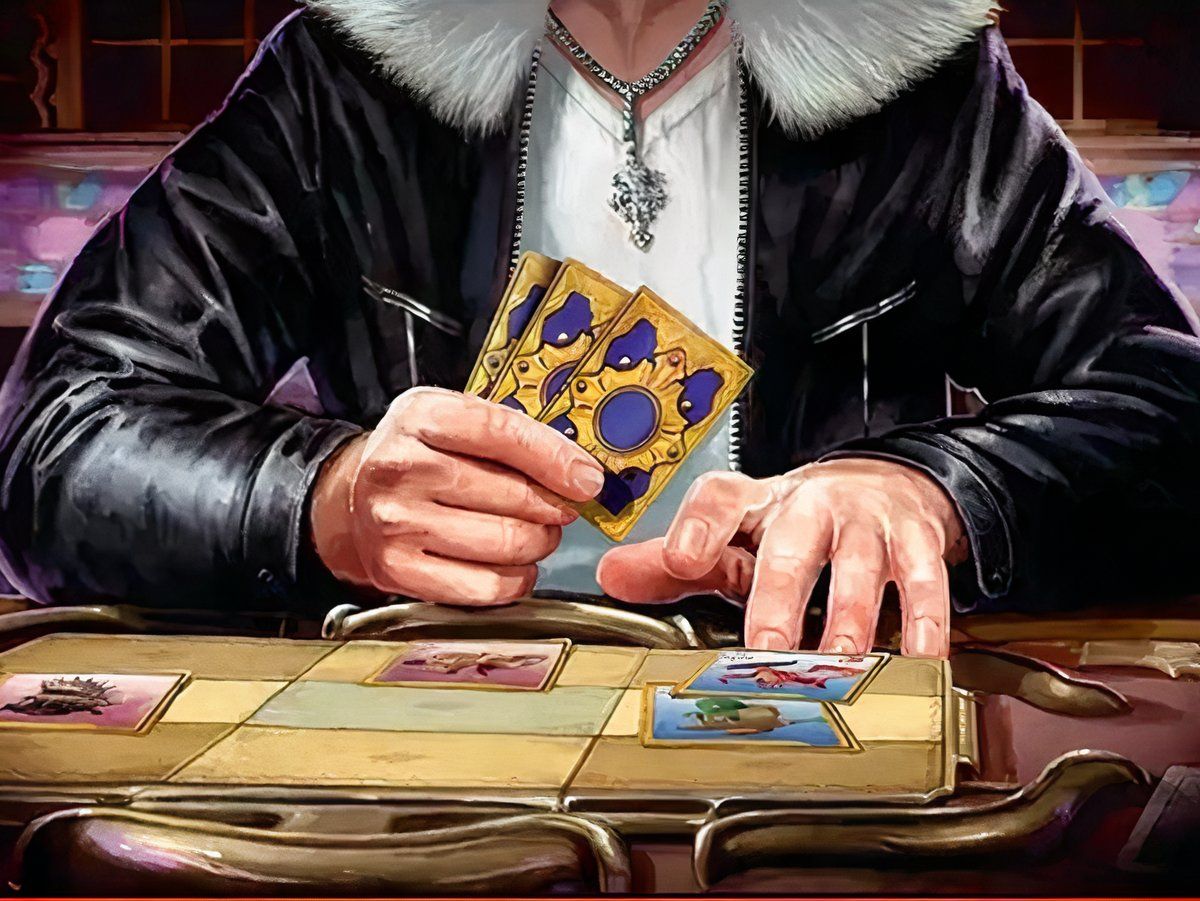
One Grotesque 1999 Card Makes an Underrated Final Fantasy Commander a Total Powerhouse
Overview & Key Takeaways
A forgotten 1999 Magic card transforms Squall, SeeD Mercenary into a powerful Commander while capturing his Final Fantasy 8 character arc.
Four days after Final Fantasy 8 launched in Japan on Feb. 11, 1999, Magic: The Gathering released an unassuming little creature called Bone Shredder as part of its Urza’s Legacy expansion. I was 9 years old and oblivious to both events. Somewhere out there, while Japanese players were exploring Balamb Garden as Squall Leonhart for the first time, people were cracking open packs of Magic containing a nasty little Phyrexian that grinds up bones. 27 years later, I realized how perfectly they belong together.
Final Fantasy 8 was the first Final Fantasy game that truly felt like mine. I borrowed it from my cousin in the summer of 1999 and was blown away by the cinematic quality and epic storytelling of JRPGs. That newfound obsession quickly brought me to Final Fantasy 7, Final Fantasy Tactics, and then the older games in the franchise until the ninth mainline entry was released. That FF-driven obsession with high fantasy probably helped lead me to Magic sometime in the early 2000s.
When Magic’s Final Fantasy Universes Beyond set transformed Squall into a white-black legendary creature, I decided to build a Commander deck around him regardless of whether he was actually any good. At first glance, Squall, SeeD Mercenary looks like a fairly ordinary Voltron Commander, which refers to a kind of strategy that sees you load one creature with equipment, auras, and other buffs until it becomes capable of killing players almost single-handedly.
 Image: Wizards of the Coast
For two white, one black, and one colorless mana, Squall is a 3/4 Human Knight Mercenary with two abilities. The first, named for his Rough Divide Limit Break, gives double strike to any creature you control that attacks alone. The second returns a permanent card with mana value three or less from your graveyard to the battlefield whenever Squall deals combat damage to a player.
The obvious strategy is to buff Squall, have him attack alone, and try to knock out each opponent with 21 points of Commander damage. But if Voltron is your preferred strategy, there are a lot of better Commanders out there. Squall costs four mana and has no built-in evasion or protection. A single removal spell can derail your entire game plan. His recursion ability initially looks like a useful bonus attached to an otherwise unremarkable Voltron Commander. Building him becomes much more interesting when you reverse those priorities, which is a thought that occurred to me when I discovered a copy of Bone Shredder in a box I’ve had for about 25 years.
The secret to Squall is letting things die
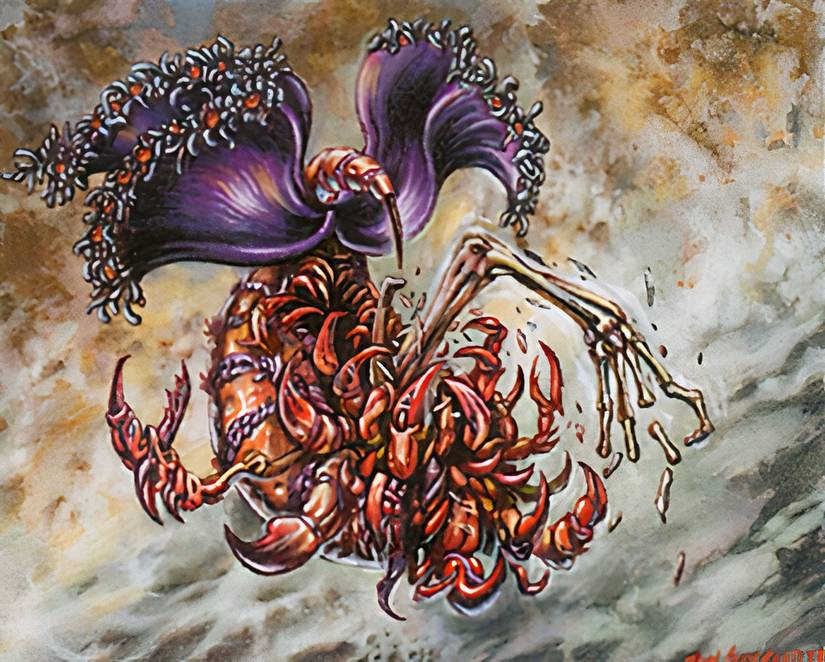
Art for Bone Shredder.
Image: Wizards of the Coast
Bone Shredder is an uncommon creature that looks like a flying stomach crossed with a biological wood chipper. In a retrospective published by Bogleech, original artist Ron Spencer recalled being asked to design a flying mollusk or crustacean, an assignment that forced him to think outside his “usual monster formula.” Rather than simply attaching insect wings to a crab, Spencer used a milkweed pod as the basis for its shell, assembled its jaws from assorted lobster and crab claws, and covered the edges of its coral-like wings with tiny eyes surrounded by hairlike cilia. The hook rising from its body is a stinger meant to paralyze its prey before the mass of legs and pincers below grind up the victim’s bones. Hence… Bone Shredder.
Spencer reportedly even gave the species a mock taxonomic name in an old issue of InQuest magazine: Pterogastrula osteophagus, or, roughly, “winged stomach bone-eater.” It is delightfully revolting, but oh-so-elegant for a Squall deck.
 Image: Wizards of the Coast
When Bone Shredder enters the battlefield, it destroys a nonartifact, nonblack creature. It also has echo, an old mechanic that forces you to pay its three-mana cost during your next upkeep or sacrifice it. Yet I realized that’s oddly perfect for Squall. If you can trigger his recursion ability consistently, you’ve got a way to destroy a creature every single round before you let Bone Shredder die from echo and then drag it back out again. Bone Shredder sets up a highly effective loop, but filling up the graveyard through other means is a priority.
Buried Alive, a three-mana sorcery, lets me search my library for three creature cards and put them directly into my graveyard. With that, I can grab Bone Shredder (potentially in turn three) and two more cards like Mother of Runes for some much-needed protection, along with Fang, Fearless l’Cie so I get to draw a card every time a creature leaves my graveyard. By round five, I’m (hopefully) connecting with Squall and dragging two of these cards to the battlefield.
But Squall’s ability targets any permanent card that costs three mana or less, which means he can recover artifacts, enchantments, auras, equipment, and even lands. If someone destroys Land Tax or Black Market Connections, Squall can bring them back to keep those engines active. Other than cards like Bone Shredder and Accursed Marauder, some of my removal comes from carefully chosen enchantments like Chains of Custody and Sheltered by Ghosts. Go ahead. Destroy them! (But please do not exile them or I will cry.)
My robust artifact package is a mix of equipment that offers more firepower (Sword of Hearth and Home, Machinist’s Arsenal) and protection (Swiftfoot Boots, Darksteel Plate). But there are also artifacts like Dispeller’s Capsule and Wayfarer’s Bauble that are middling in most decks but suddenly deliver consistent value when Squall is able to bring them back from the graveyard.
Cards like All That Glitters make Squall a considerable Voltron threat as it scales with the number of artifacts and enchantments I put on the board (there are 29 in the deck). I don’t have to win through Commander damage, but if I manage to get All That Glitters and Machinist’s Arsenal on Squall at the same time, that’s +15/+15 when there are only five artifacts in play. Once Squall gets trample from Shadowspear and/or flying from Foot Chopper — or even combat damage negation from Dolmen Gate — survival and dealing some kind of damage to a player becomes that much more certain.
In practice, it’s the kind of quiet, unpredictable deck structure that doesn’t draw a lot of attention at first. But my opponents can’t afford to let Squall connect, because I can rebuild my entire board if Squall connects just once. Even if I trade some of my other creatures in combat, most of them cost three or less mana anyway, so Squall can bring them back later.
Squall fights alone, but he never stays that way
 Image: Square Enix
When I first saw Squall’s card, I have to admit that I was pretty disappointed. Some Final Fantasy cards do a terrific job at showcasing a snapshot of a character’s journey, or in the case of Zack Fair (who is also in this deck), they tell an entire story through their mechanics. Returning cheap permanents from a graveyard initially seemed pretty generic.
Rough Divide is the obvious exception. In FF8, Squall performs the Limit Break by charging toward an enemy, slashing upward with his gunblade, and firing its chamber at the moment of impact to create an explosion. Double strike perfectly represents the sword connecting and then the gun firing.
Even the requirement that a creature attack alone feels tailor-made for Squall. He begins FF8 as a withdrawn teenager who is emotionally guarded, thanks to trauma he can’t even remember. Squall convinces himself that relying on other people will only give them the opportunity to leave him.
The more I worked on the deck, the more I realized that Squall’s recursion ability reflects his entire character arc in an abstract way. Squall ultimately becomes a leader willing to risk everything in order to bring people home. Over the course of the game, he carries an unconscious Rinoa across the Horizon Bridge in search of Ellone, rescues her after she is abandoned in space, and breaks her out of the Sorceress Memorial when Esthar tries to imprison her.
FF8 plays a lot with memory and relationships, and Squall ultimately becomes the glue that holds all of his amnesiac companions together. It’s a story preoccupied with recovering what has been lost. Guardian Forces cause Squall and his companions to lose their memories. Ellone’s mysterious power lets people revisit the past through someone else’s memories. The final conflict against Ultimecia takes place within Time Compression, a surreal attempt to collapse past, present, and future into a single moment.
 Image: Square Enix
Squall’s card reaches into the graveyard to find what has been lost, and then he brings those things back into the present. The fact that he must attack alone to do it is kind of brilliant — and it sort of feels like that iconic moment where he and Rinoa are reaching out to one another. (It’s kind of a shame that she’s in white-green, so you can’t reenact their romance in a game of Magic).
Squall, SeeD Mercenary is hardly one of Commander’s biggest powerhouses, though he is more popular than I expected: According to data from EDHREC, he is currently the 350th most popular Commander over the last two years. Most of those decks, however, lean on auras and equipment to buff Squall and use cheap creatures that make all players sacrifice a creature in play. There are a few more costly cards I’d love to get that are perfect — like Teval’s Judgment, Sigarda’s Aid, Buster Sword, Entomb, or even Esper Sentinel. But many of those are kind of generic goodstuff cards in these colors, or simply emphasize equipment.
Building this deck delivered exactly the kind of challenge I want out of Commander. The process is the most satisfying when it sends me digging through decades of Magic history for some undervalued card that suddenly becomes indispensable. Bone Shredder is a perfect example: a forgotten creature from last century that nobody plays all that much because of an annoying ability that makes it perfect in this deck.
Bone Shredder and Squall entered the world four days apart, then spent 27 years taking separate routes into the same deck. Every time Squall attacks alone and brings that strange little Phyrexian assassin back with him, two pieces of my childhood finally connect.
I still have some tinkering to do, mainly to remove some generic creatures and incorporate some worthy cards from The Hobbit set into the mix. But check out my decklist on Moxfield — it’s named Renzokuken after Squall’s ultimate Limit Break — and offer up any suggestions in the comments.


