Metro 2039 Dev Reveals How the Ukraine War Led to the Series’ Darkest Game Yet
Overview & Key Takeaways
Metro 2039 offers players the freedom to explore a war-torn landscape as they see fit, with a dark story and confined spaces that recall series roots.
Life feels much different today than it did in 2019, when Deep Silver published Metro Exodus on PC and consoles. The people of Ukraine have endured more impactful changes than most. On February 24, 2022, Russian forces launched a full-scale invasion of Ukraine. The two nations have remained locked in conflict ever since, at great cost to the many innocent citizens caught in a power struggle they never wanted. For the developers at 4A Games, who have been working on the very dark Metro 2039, that event was impossible to ignore.
Due to launch in February 2027, Metro 2039 is the next chapter in the story that began in 2010 with Metro 2033. The grim first-person shooters are based on the works of novelist Dmitry Glukhovsky, who first partnered with 4A Games to bring his dark vision to life. Metro Exodus, the third installment in the resulting series, finally dared to dream of a brighter future. But the demo of the new game that I played for several hours makes it clear the franchise is in no danger of going soft. There’s still too much darkness remaining.
In a video interview with Polygon, Metro 2039’s executive producer, Jon Bloch, discussed the shift that occurred in the game’s development, following Russia’s invasion.
“We had to rethink our story,” Bloch told Polygon. “Ideas we had of things that we had to get right with the first iteration of the game completely changed, so now the story was going to be the most important thing… We needed to basically take all the emotions of the team and everything that the team and everyone in Ukraine is going through and find a way to tell the right story.”
 Image: 4A Games/Deep Silver
Many of the original ideas were wiped away, and development essentially began a second time. The plot now focuses on the consequences of war. According to creative director Andriy Shevchenko, Metro 2039 is “a game without heroes.” The new protagonist, known simply as the Stranger, is driven not by heroism, but by personal motivations. In a landscape ravaged by war, altruism fades into darkness. Metro 2039 is a game without heroes because it takes place in a world without heroes.
The demo I played began roughly halfway through the story, with many of the plot’s details purposefully obscured. The Stranger appeared in an underground office, at the conclusion of a meeting with a representative from a rival faction. The encounter had not gone well. The hostile visitor stumbled away, promising violence. Unconcerned, the Stranger sat down across the desk from the local faction leader and offered to do something about the situation, finally securing the other man’s reluctant blessing before leaving the cramped space to get to work.
The demo’s earliest moments included plenty of dialogue, spoken by strangers glimpsed through windows, by vagrants huddled shivering on benches, and even by the Stranger himself. It’s the first time in the mainline series that the protagonist can talk (the protagonist in Metro Awakening VR spoke, as well), which allows him to share his opinions and motivations. The developers anticipate players will be excited about the change, and it’s easy to see why. Even from his brief interactions with others, I could tell the Stranger is not one to sit idly by as the world shifts around him. He’s more the type to grab the bull by the horns.
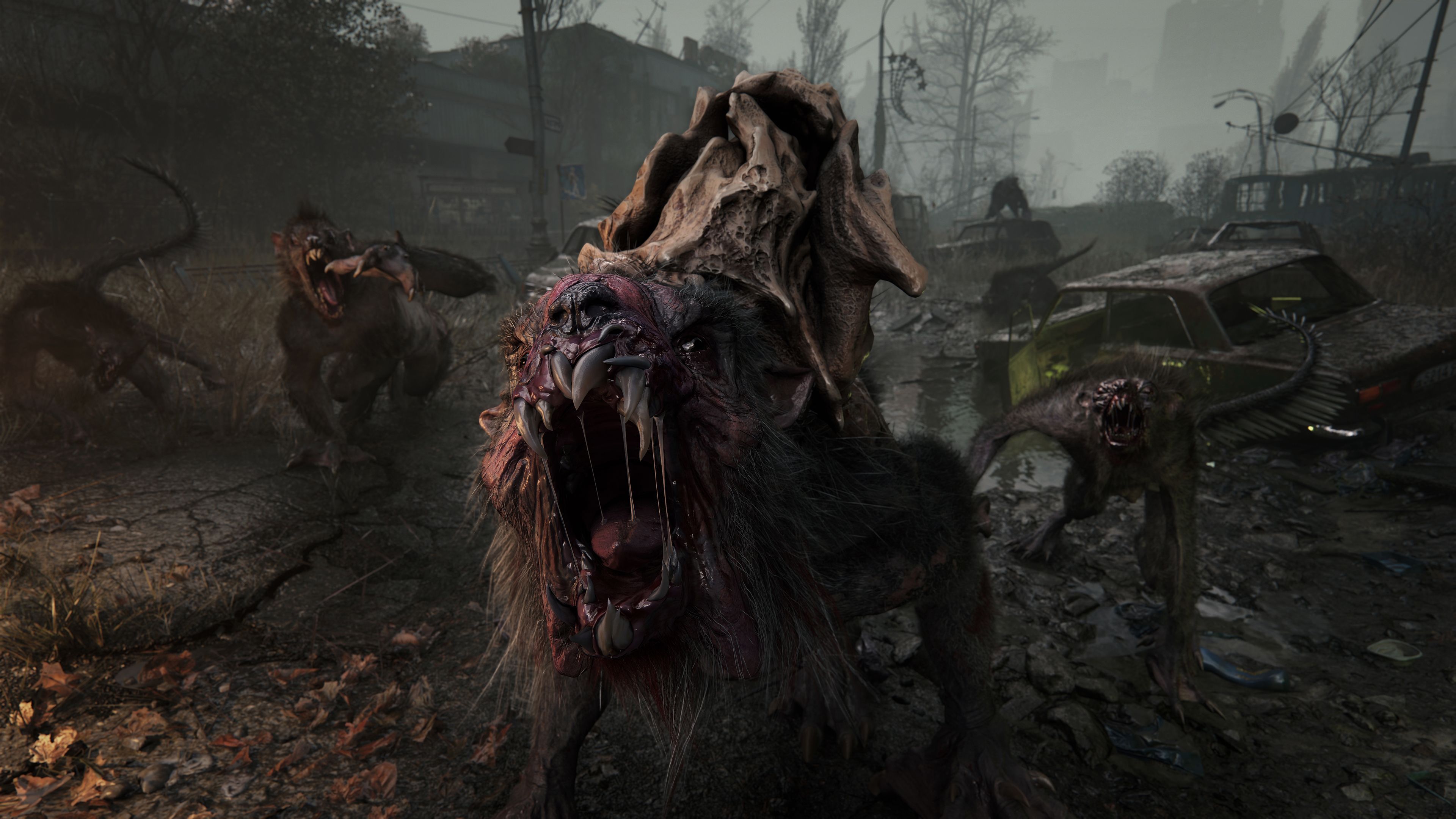
The Stranger’s aggression and confidence will prove useful throughout the game, I suspect. The world outside the tunnels is formidable, populated by monsters, people, and curious mixtures of the two. When I first reached the surface, I surveyed a mist-shrouded alleyway littered by ruined vehicles. Mongrel mutants slinked between them, wretched but dangerous. When I foolishly tried to cross the street too close to the local wildlife, a pack of beasts converged on me. I died almost immediately.
 Image: 4A Games/Deep Silver
Quick deaths became a recurring theme over my next few hours of play. Whether the Stranger collapsed to the ground, gasping for air, or an enemy mercenary hit the floor, gurgling with a knife sticking out of his neck, the world remained suitably grim as the bodycount ticked upward. But violence isn’t always necessary. There are times when a more considered approach pays dividends. By the developers’ count, the military complex building where much of the demo takes place has three or four ways to enter it, a standard that applies to numerous other locations across the full campaign.
I wondered if that means Metro 2039 is built to reward a more passive approach from start to finish. It seemed unlikely, given the role violence serves in the story. My suspicions were confirmed during a bloody demo. Sometimes, the violent approach will prove necessary. You’ll punctuate your entry with guns, grenades, and molotov cocktails. But there will also be moments when, observing an area ahead, you’ll notice opportunities for stealth.
“We try to provide players with different types of approaches to suit their play style,” Bloch explained. “If they want to go in loud or if they want to go in stealth. If they want to go in stealth, they still also have multiple choices of paths they can take... We try to put as much of that variety into those [sub locations] as we can.”
And the quiet approach will let you witness more of the world around you. In my time with the demo, particularly as I learned the environment’s layout and explored outlying buildings, I frequently ran out of filters. It’s the sort of blunder that quickly turns fatal in Metro 2039, since the Stranger needs clean oxygen to breathe. Outside of battle, I used scavenged supplies to craft more filters, but that wasn’t possible when I hastily made too many health packs that required the same precious ingredients.
 Image: 4A Games/Deep Silver
The developers mentioned they are still working on the game’s balancing in that respect. They also noted that outside the demo, players will have access to more resources. For example, they may be able to equip additional suits. Risk comes with the territory, but players should anticipate that if they have to work harder to navigate an unfamiliar area, they can leave with something nice. “There’s always a reward,” said Pawel Ulmer, the game’s co-creative director and lead audio designer.
Even in the demo, with its confined spaces, I appreciated the freedom to explore and land myself in hot water. The environments often consisted of multiple floors, whether in ramshackle buildings or subterranean sewers. I frequently felt confined and ill at ease, even while above ground. When I spoke to the developers, a word that came up a few times was “claustrophobic.” They referenced the “sandbox” environments in Metro Exodus, while also making it clear that Metro 2039 represents a return to form. That’s very good news for anyone who might have felt the series lost something when it gained more open environments.
Despite the dark future it so convincingly portrays, Metro 2039 is a lot of fun to explore. My demo didn’t always come together quite the way I might have preferred, but I had a great time poking around a small slice of the grim world. The environments always gave me something to do, while leaving me to wonder how I might approach them differently on a subsequent run. All of that is by design.
“We tend to actually not write a lot of design documents,” Bloch said. “We tend to talk about ideas and then go prototype them and make them. And if they’re not fun, they either evolve into something completely different or they go away.”
From what I experienced, that development process is working just fine so far.